Wednesday, 25 August 2010

The "No Impact Week" Experiment and other news

I've been feeling despondent since Tigerlily's death. It's not going to stop me from fostering and rescuing animals in future, of course, but I just need a week or two to grieve and to overcome caregiver fatigue. I am grateful for everyone's kind words and condolences for my little Tigerlily.

Pouring all my energy into my work and volunteer commitments helps me cope with the knowledge that I didn't and couldn't save Tigerlily, reminds me that I am part of something bigger than myself and calls to my attention my pledge to put service before self.


Kota Damansara Community Forest Park trail clearing session on Saturday, 21st August. I am glad I remembered to bring my biodegradable rubbish bags, despite the grief and confusion which immediately followed Tigerlilly's death.


A recent freak storm had uprooted some trees and damaged part of our trails. We agreed to help with the trail clearing in the interests of environmental education. If the local community does not have access to the forest park, they would not feel any sense of stewardship or love for it.


My colleague and buddy Marvin was a wonderful asset to us on Saturday morning. His jungle and knife skills made up for the fact that many of the other volunteers there were n00bs with machetes. And a n00b with a machete is a dangerous n00b. "In my tribe, you have to earn the right to carry a knife", Marvin told me. I have to concur with him.


The Kennel D Dogs at the SPCA looked and smelled clean and pleasant after their bath. I had also cleaned and disinfected the kennels after bathing and tickwashing the dogs. These dogs have just been given their chew treats, as I believe in positive reinforcement and want the dogs to associate volunteers and baths with something nice.


"This is my treat. Mine. All mine."


"Close, but no cigar!"


~ The No Impact Project Experiment ~

I had signed up for the
No Impact Project Experiment a few months ago, which is described as an 8-day carbon cleanse to help participants make lifestyle changes that will reduce their carbon footprint and help us understand how a lifestyle that is gentler to the environment can improve our quality of life.

I registered as a participant partly to see what other measures I could take beyond those I am already practicing, and partly because I hope to initiate a "No Impact Week" project on a large scale in the Klang Valley next year. After all, our actions must reflect our environmental values. I cannot hold forth on the deficiencies of REDD or cap-and-trade until my own environmental track record is beyond reproach.

Here are the guidelines and my basic plans for No-Impact Week:

(Note: I will have to drive on Tuesday as the Bentong Farm Sanctuary Helping Hands Visit had been planned weeks in advance and my friends are looking forward to it. However, we will be going 4 persons to a car so it is going to be quite a fuel-efficient trip. Nevertheless, Day 3 of my No-Impact Experiment will be pushed to Wednesday and the rest of my No-Impact Week will resume from there.)

Day 1: Consumption
I will have to audit every purchase I make and save all the rubbish I generate for the entire day in a plastic bag, to be taken out and reviewed the following day.

Day 2: Trash
Trash generated the day before will be separated, audited and reviewed. Participants are urged to rethink their consumption patterns to reduce waste.

Day 3: Transportation
Participants audit the number of fuel miles they travel each day and think of ways to reduce private vehicle usage / fossil fuel usage. Participants are encouraged to experiment with public transportation, ride-sharing programmes and alternative modes of travel.

Day 4: Food
Participants take their food list for whole week and calculate its Foodprint. Where did it come from? How did it get here? What is used in its production? Participants are encouraged to buy local, organic and fair trade whenever possible, and to opt for the least processed and least packaged foods.

Day 5: Energy
Participants carry out home and office energy audits and take action to reduce energy use. Which appliance is used the most? What can we do without? How can we reduce the number of electrical appliances we own and use?

Day 6: Water
Participants analyse their water footprint. How much water do we use at home and at work? What measures can we take to reduce our water use and wastage?

Day 7: Giving Back
Day 7 is spent on community service and environmental projects, and finding ways to contribute regularly to environmental movements and community initiatives.

Day 8: Eco-Sabbath
Participants analyse how they usually spend their day off, and think up what they can do on their rest day that doesn't require electricity, fuel, water wastage and/or unnecessary consumption.


Think you can own the Experiment? Then sign up for to participate in the next No Impact Week here!

Monday, 23 August 2010

Farewell, my beloved Tigerlily


Rest In Peace, my beloved Tigerlily
~ Best Kitten In The World ~
(?? August 2010 - 21st August 2010)

Tigerlily died around 0400 hrs on Saturday, 21st August 2010. Perhaps our world had no place for anything as good but as fragile as my beautiful Tigerlily.

She had been doing so well in the last six days. She was the best kitten anyone could hope for. She had even started learning how to lap milk from my palm. On Friday morning, she had mewed for milk, and I had fed her twice in the morning. In the afternoon, when I fed her, she seemed a little quiet, but dutifully drank an ounce of milk and curled up into a ball and went back to sleep.

By 1630 hrs or so I was getting concerned because she seemed uncharacteristically quiet. I tried to warm her up in my hands and she purred with pleasure. Still, I didn't want to take any chances and drove her to the vet immediately. Kind Dr. Steven inspected Tigerlily and declared her free of infection or illness. All her vital functions were fine. Her airway and lungs were clear, she was not dehydrated or constipated and she showed signs of good health such as sucking on our fingers and wanting to nurse. He advised me to keep her warm and not only did not charge me for the check-up, he sent me home with a pack of PetLac milk, a tube of Bene-Bac for kittens and a new feeding bottle, all free of charge. I went home happy that there was nothing wrong with Tigerlily and convinced that the world is full of good people.

By 2100 hrs it was apparent that something was very wrong. Tigerlily was very weak and could hardly drink milk. She tried to mew but no sound came out of her tiny mouth. I called up Dr Steven and he offered to return to his clinic for her. I drove Tigerlily to the clinic, aware that she was already fading away.

The next 3 - 4 hours were among the worst in my life. The good doctor gave Tigerlily IV fluids subcutaneously through a syringe as she was too tiny to be put on drips, and nebulised her every 5 minutes. The reason for her sudden deterioration was still unclear. There was nothing wrong with her, except that she was very, very weak. I held her tiny body in a towel, pleading with her to respond to the fluids and oxygen and recover.

By midnight, the vet and I bowed our heads in prayer and prayed earnestly for little Tigerlily's recovery. We needed a miracle now, and I sent out urgent requests for everyone's prayers. That Special Someone called up and began praying with us. Tigerlily's breathing became laboured, but at least she was still alive. I held her and kissed her, trying not to let my tears soak her fur and cause her to catch a chill. Despite the weak state she was in, Tigerlily purred and looked at me with eyes full of love. She raised one tiny paw and tried to touch my face, but she was too weak and her paw could not reach me. I lowered my face so she could have contact with my skin. She tried to keep her eyes open but even that took all of her strength.

By 0130 hrs, Dr. Steven informed me that we have done the best we could and that he had given her the maximum safe amount of glucose and oxygen. There was nothing more we could do for her. I wanted to bring Tigerlily home so that I could keep her warm and close to me. I woke up every few minutes to check on Tigerlily in her little carrier. Tigerlily breathed her last around 0400 hours. I closed her eyes with my hands and wept for the tiny kitten who took such an important position in my heart and life.

I woke up around 0700 hrs as I had promised Pasupathy and the other Nature Guides that I would assist them with the Kota Damansara Community Forest Park trail clearing. A recent freak storm had uprooted many trees and damaged the trails, and we had agreed to clean the trail up on Saturday morning. I felt terrible and looked terrible, but a promise is a promise, and I have to keep it. I had slept in my clothes and my hair was unkempt when I drove to the Kelana Jaya LRT station to pick up my friend and fellow volunteer Marvin.

I did a terrible job of trail clearing that day. My machete was blunt and I could hardly hack at the overgrown Bertam palms and weeds. I chopped at fallen trees listlessly and tugged at weeds. I had brought biodegradable garbage bags with me and managed to fill two of them with litter. Thankfully, Marvin made up for my lack of productivity and worked like a Spartan soldier. I had no appetite for breakfast as all my thoughts were on Tigerlily and her tiny lifeless body, still in the carrier. Marvin offered to help me with her burial and last rites and I was grateful for his help.

We returned to my bachelor pad to find Tigerlily's lifeless body covered in ants. I was very distressed and remorseful. Marvin helped me wash her body under the garden tap and remove the ants. He suggested burying her in a large earthern pot and growing new plants in the pot that I could take with me when I move house. I agreed with his idea. Marvin dug up soil from my compost pit to fill the pot with. I lay Tigerlily's tiny body on top of an Asplenium nidus leaf in her final resting place. I recited the Pattidana and we covered Tigerlily's body up with soil. Marvin informed me of their Bidayuh tradition of returning all things to the soil and letting them become part of new life. He made a burial mound in the pot and informed me that it was because the soil in the middle would sink within a few days, and a barrow-like mound would help keep the soil level. He clipped 3 stalks of one of my garden plants and asked me to push them into the soil in a small triangle as I recite my final prayers for Tigerlily. We then arranged flowers around the pot and I placed in the pot a small limestone rock upon which I had written Tigerlily's name with a Sharpie. We sprinkled water to help the new plants grow and bade Tigerlily goodbye.

I was grateful and reassured to have Marvin with me in my time of grief, as he is a good friend and colleague and he had enjoyed Tigerlily's company in her short time with us.

Tigerlily, I hope when you are reborn, you will know how to find me, so we can be together again. I will never forget you, my beloved child.

Wednesday, 18 August 2010

Tigerlily: Good Thing, Small Package!

It's funny how it's always the tiniest things that have the strongest grip on your heart.


Tigerlily came into my life on Saturday, 14th August, when I was at the SPCA shelter.

It was late in the afternoon, and the staff and vets have gone home. I had finished bathing and tickwashing the dogs in Kennels D and E and was in the midst of cleaning and disinfecting the cat enclosures in the front area when a lady and her son came to our gates to surrender an orphaned stray kitten that they found at the roadside the same morning.

The kitten was a tiny calico which appeared to be around 1 - 2 weeks old. The lady had the best of intentions when she prepared a saucer of milk for the kitten, but of course the kitten was too little to lap and unable to digest processed cow's milk meant for human children. The lady was at her wit's end and finally surrendered the kitten to the SPCA in the evening, either to be put to sleep or to be put up for adoption.


I took one look at the kitten and was smitten. I made an immediate decision to foster her. I took down the lady's particulars and issued her an official receipt for the donation she made to the shelter, and hurried through the rest of the cleaning in order to bring my latest ward home. I decided to name her Tigerlily on impulse (both because she looks like a tiger cub and because we're into rock stars and their offspring at the moment).

It has been a week of satisfactory progress, where Tigerlily is concerned. Tigerlily is growing stronger on Kitten Milk Replacer, Hartz Cat Vitamins and Benebac and has been eliminating waste on cue. She doesn't cry as much as she did on the first day anymore, as she is no longer hungry and cold. I have been bringing Tigerlily with me wherever I go in order that I may attend to her needs and feed her every 2-3 hours.

Bringing Tigerlily to work wasn't the challenge I had thought it would be. Many of my colleagues have fostered young animals at the office before and management seems to be quite blase about it by now. I hid Tigerlily's carrier in the guardhouse with our distractingly handsome Nepali security guards, who were very obliging and informed me that they "also very much love cats".

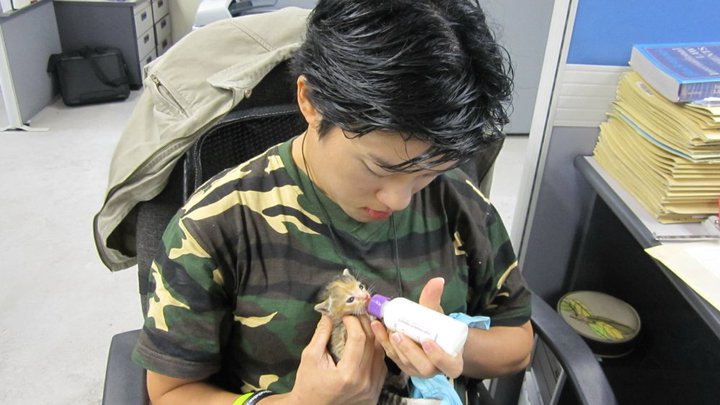
I would make or warm up a portion of milk every 2-3 hours and go out to the guardhouse to bottle-feed Tigerlily and clean her up with toilet paper and warm water. At 1700 hrs each day, after official work hours, I would bring Tigerlily in her carrier into my cubicle, where I could keep a constant eye on her and respond to her requests for more milk or a cuddle.

Conventional wisdom would have one believe that having a kitten in one's office would naturally reduce productivity at work. On the contrary, knowing that Tigerlily depended on me for comfort, warmth and sustenance motivated me to work faster and better as I now had new goals. "Hang in there, Tigerlily", I'd say. "I've give you your next feed as soon as I complete drafting this particular report".


Tigerlily having her fill of milk in my office.


Tigerlily loves me right back!

In the days before I had Tigerlily in the office with me, I would fritter away time talking trash with my colleagues and watching appalling and pointless videos on YouTube such as "Banglar King Kong" in the evenings. Now my workmates crowd around me and watch me feed Tigerlily instead, and offer me things like toys that Tigerlily has no use for, or make unhelpful observations such as "She is so tiny" or "She looks fragile". Gee, thank you, Captain Obvious! Tigerlily is two weeks old -- what do you expect?

I hope that Tigerlily will continue to grow stronger and healthier and that I will be able to find her a good home in 3-4 months. I hope to rehome her with friends in order that I will still be able to visit her and play with her, or have her board with me during the holidays. That Special Someone has been an amazing pillar of strength to me and I have him to thank for all his guidance on bottlefeeding and caring for orphaned young animals.

Tigerlily aside, my days are packed with work, social and volunteer commitments. Now that I am the Vice Chairman of the Malaysian Nature Society (Selangor Branch), I have to devote a certain amount of time each month to administrative matters, drafting letters, reviewing policies and papers and plowing through academic papers and journals.

Also, my proposal to conduct a periodic volunteer induction programme at the SPCA for new volunteers went down really well with the secretariat and committee.

Here are the objectives I listed for the programme:
1. To encourage more members of the public, especially young professionals and college/ university grads/undergrads, to volunteer with the SPCA.
2. To build up a pool of volunteers with expertise and abilities in different fields, and to capitalise on their strengths and interests.
3. To create a network of support for the SPCA.
4. To help animal-lovers develop animal care skills in order that they may pursue their own rescue and fostering initiatives in future, thus benefiting a larger number of needy animals and reducing the burden on SPCA's resources.

During a recent discussion with one of the SPCA officers, I tried to put forward my arguments in favour of getting volunteers to do hands-on feeding, bathing and cleaning work. However, the said officer believed that volunteers shouldn't have to get their hands dirty doing hands-on work. In my proposal, I held forth on my reasons why I wanted hands-on work to be part of the induction programme:

1. It is precisely because new volunteers are not allowed or encouraged to do real work such as bathing dogs and cleaning kennels and catteries that they feel their services are not needed and they do not return.

2. (In relation to safety concerns:) All volunteers have the potential to handle even difficult or aggressive dogs and cats, and treat minor injuries and ailments, provided we equip them with the knowledge, skills and confidence to do it.

3. Volunteers need to know that everything they do helps animals directly. A clean shelter helps improve the health and safety of animals, and increases the animals' chances of adoption, i.e. visitors stay longer if a shelter is clean and pleasant-smelling.

4. Volunteers need to know that everything they do changes lives permanently. As an illustration of this, I refer to the time Reve and I gave a long-haired black mongrel a haircut and a bath. The dog had been in the shelter for months. Within 10 minutes of bathing and grooming the dog, someone took a shine to him and adopted him. So volunteers create chances.

5. There is no shame in doing hands-on work. It keeps us grounded and aware of what is going on in the lives of the animals and helps us develop analytical and practical skills that we can't acquire through reading/observation alone.

6. Doing hands-on work helps volunteers develop the skills and confidence needed to be fosterers and rescuers in future. Volunteers who are never encouraged to clean cages will feel squeamish about the idea of cleaning out the cages and litter trays of animals that they intend to foster and may begin to believe that they will not be able to 'cope with the work'. Hands-on volunteering will provide them with sufficient practice and confidence.

The committee and officers recognised the merit in my argument and plans are now under way to draw up a volunteer induction SOP. Things seem to be going really well so far at work, MNS and SPCA.

Sometimes, though, my delusions of invincibility are tampered by reality. I had a little health scare recently. I underwent my annual medical examination yesterday and learned that my blood pressure, at 130 over 90, is a little on the high side. I was aggrieved and indignant. I don't know what I have done to deserve high blood pressure. After all, I don't smoke, drink, eat meat or live with my parents. Why should I have high blood pressure? My colleagues averred that they had the answers:
"Because you're always drinking coffee or Red Bull."
"Because you eat fries and chips almost every day."
"Because you're not getting enough rest."
"Because you work too late".
"Because you have too many things on your schedule."
"Because you're always running from one activity to another".

Their candor would be appreciated if only it weren't so painfully accurate. I acknowledge that I have to start taking better care of my health. And it begins with running around the neighbourhood park for half an hour every evening when I get home from work, without taking a break for ice cream or thosai.

The reason for my sudden determination to exercise is not due to any alarmist concern over my health, which seems okay to me for the time being, thank you very much. It is that I have just registered to participate in the Malaysian Nature Society Post-AGM full hike up Gunung Ledang in September, despite the fact that I am out of shape and in no state to complete a 14-hour hike up a 1,276 metre-high mountain. Guess it's time for me to oil those joints and get those muscles in gear. The road beckons. So long, until we meet in cyberspace again!

Wednesday, 11 August 2010

Memories of Langkawi

~ Memories of Langkawi ~

i.
The Andaman Sea
Reflected in your shades
Sparkles like your smile.

ii.
The senile engine
Roars into its rented life
We're on the road again.

iii.
Brine and breeze
In your hair and my sundress.
Sand between our toes.

iv.
The days ahead hold
The promise of adventure.
Rules cannot bind us.

v.
Down at the kart tracks
I trace your trajectory
Trying to catch up.

vi.
Gravel deflects off
The visor that screens my pain
From your knowledge.

vii.
The rush of octane
Tapers to a standstill.
I yield to your touch.

viii.
You hold my blistered arm
And offer conciliatory
Ice lollies and balm.

ix.
Your six-foot frame
Silhouetted against the sky
Buoyed by the winds.

x.
A gentle descent.
In the shallow foaming surf
You return to me.

xi.
The limestone pinnacles
Jewelled crowns and lit candles
Celebrate our union.

xii.
Sylvan symphony.
Nothing but the forest and
The secrets it keeps.

xiii.
Fertility Lake.
In its dark primordial waters
We paddle, insouciant.

xiv.
Full fathom five
Neptune's force ebbs and eddies
Around us, callous.

xv.
Island eventide.
In the shadows we embrace
Solace in silence.

xvi.
Your sonorous voice
Reading to me of cows and gaurs
Lulls me into slumber.


Friday, 6 August 2010

Wag & Walk Weekend and other news

Sunday, 1st August 2010: SPCA Wag & Walk


Nature trails and outdoorsy dogs -- Can there be a better combination than this?

It was with the aim of bringing the two together that SPCA Selangor held our second "Wag and Walk", a fun nature hike designed to bring dogs and dog-lovers together, at the Kota Damansara Community Forest Park last Sunday.

Co-organised by Casa Pet Store, the event had the objective of raising funds for the SPCA's new eco-friendly animal shelter.

I was recruited as a volunteer by Jacinta and team, and so I had to rise early on a weekend morning to assist at the Registration and sales booths. Although it was announced that registration was limited to 80 dogs and their handlers, we could not turn away many people who had come all the way to the Park with their dogs to enjoy nature and to socialise with other dogs and people, and so they were allowed to participate in the event although they were not entitled to goodie bags.


Early birds (or rather, dogs) at the head of the trail, waiting for the walk to be flagged off.


Taro the Bull Terrier showing us his commando crawl. Good job, Taro!


"I wonder if there are monkeys and squirrels for me to chase in there."


"Please don't leave us behind!"


Happy dogs and people upon returning from their 2km walk.


The dogs were given drinking water upon concluding the walk, while their humans were given newspaper sheets to clean up after their dogs with!

The event did not just end with the conclusion of the 2km walk. The organisers had lined up 6 exciting and entertaining games for the participants. The games included a "Waggy Tail" contest, a ball-retrieving contest, a "Simon Says" game and a doggy tennis competition which entailed the dog running back and forth between two handlers.


Handlers walking their dogs in a circle during the "Simon Says" game.


Two youngsters and their remarkably obedient St. Bernard were the finalists in the "Simon Says" game.

The event was officially over around 1230 hrs. Most of the food had been sold, and the unsold food was given either to the volunteers or brought back to the SPCA shelter for the staff. The merchandise, banners and trestle tables were packed and loaded onto the SPCA pickup truck. I wanted to make sure that we left the forest park in a better state than it was when we arrived, and so I mobilised other volunteers into helping me pick up litter from the park and sidewalks and sorting out the recyclables. I was pleased with the end result, for the park and event grounds looked spotless. The volunteers and I hauled the garbage out to the curb facing the Sect. 10 school to make it easier for the waste collectors to notice the garbage and pick it up. The recyclables went with me in the Battletank to the community centre.

I departed for the SPCA shelter after the Wag & Walk fundraiser, as I knew that the services of senior volunteers would be even more critical now that Reve is no longer with us. I started work on bathing and washing the dogs in the Central Area after a short discussion with the staff on our volunteer policy and other matters.

I spent the rest of the day bathing dogs and cleaning the Catteries, kennels and shelter reception/admin areas.


“Won’t you please take me home? I make a good companion!”


Feeding time at one of our catteries.


A pre-loved cat tower provides stimulation and climbing space for our shelter cats.

Ever since Reve’s demise, we have been having difficulty attracting and retaining new volunteers. There are limits as to what I can do, as I work fulltime, have many other social and volunteer commitments and am only able to come to the shelter on the weekends and my days off.

Being mired in drudge work has never been one of my life's goals, and I have no desire to be stuck doing hands-on shelter work week after week for the rest of my life. Every organisation needs renewal, in the interests of democracy and also to allow room for fresh ideas and perspectives. I hope to be able to work together with the SPCA Committee to try to recruit and retain new volunteers, draw up a volunteer manual and create an SOP for the induction of new volunteers. Just as the goal of every animal shelter should not be to expand its infrastructure and take in ever-increasing numbers of stray animals, but to aim to educate and reach out to society to such a point that there is no longer a need for pounds and shelters, the goal of every good volunteer should be to encourage and foster volunteerism, develop better ways of working and create new opportunities for new ways of contributing and volunteering. I don't see this level of dynamism in the SPCA or Malaysian Nature Society yet, but I believe both organisations have great potential for attracting the participation, involvement and activism of members of a civil society. It's not going to be easy, but nobody's going to be able to stop me from trying.

Friday, 30 July 2010

Furry and Feathered Friends at the Bentong Farm Sanctuary

Animal welfare activists in Malaysia first heard about the Lotus Life Liberation Park (now renamed Bentong Farm Sanctuary) during the Pulau Ketam abandoned dog crisis of 2009. Many of the rescued dogs who could not find new homes were resettled in the Liberation Park, which was set up by Hai Tao Foundation, a Buddhist organisation. Located in the backwoods of Bentong, Pahang, the Park was intended as a no-kill sanctuary for animals saved from slaughter. Although the Park initially appeared to be well-run, in the later part of 2009, there were complaints of dogs going missing or barely surviving in poor living conditions.

Approximately 4-5 weeks ago, however, upon the retirement of the previous caretaker of the Park, my friends Shahrul and Jorg (who had been volunteers with the SPCA -- Shahrul was later employed by the SPCA as an Education Officer) were offered the position of caretakers of the Liberation Park. The move not only benefitted Shahrul and Jorg’s many companion animals who would now have more space to roam in, but also the Park’s dogs and cats, as my friends have many years of experience of caring for cats and dogs and treating various canine and feline ailments.


Shahrul and Jorg with their dogs.

When That Special Someone arrived in Malaysia, he was keen to visit the no-kill Sanctuary, not merely because Shahrul is a mutual friend, but also because he and I have plans to operate our own animal rescue centre and no-kill shelter one day (Our proposed shelter has no name as yet, but I have taken to jocularly calling it “Our Animal Illam”).

It would also be a good opportunity for me to explore the possibility of resettling Rocky, the little dog rescued by Vegan Eugene in April 2010 in the Sanctuary, in the event Rocky is not adopted. Judging by Vegan Eugene’s inability to make a decision, however, Rocky would probably die of old age before Vegan Eugene could make up his mind over which solution is best for Rocky. If all animal rescuers were as indecisive as Vegan Eugene, the dogs and cats would all end up back on the streets.


Shahrul had requested commercial pet food for the dogs and cats and medical supplies such as wound spray, ear cleaning solution and tick shampoo, which That Special Someone and I were happy to provide. Adik – Shahrul and Jorg’s dog – jumped up onto the backseat of the Battletank as soon as I opened the door. Perhaps she could smell the food and knew that it was meant for her!


Vaccinated and neutered cats rest in a large cage to prevent them from running away and going missing in an unfamiliar new place.


Guess who’s on top of your cage, kitties! Getting clucky over kittens, are we?


When Shahrul and Jorg first arrived, many of the dogs were emaciated, sickly, full of ticks and absolutely terrified of people. Within weeks, the dogs are now healthier, cleaner and visibly happier and friendlier.

That Special Someone was enchanted by the 104-acre farm. “Only a month ago I was looking at the pictures you posted of this farm on Facebook,” he said to Shahrul as we feasted on the organic mangosteens and rambutans. “And now here I am”. It’s funny how Providence works, sometimes.


Cows grazing in the open fields is a sight to set anyone’s chakras in balance.


Ducks and geese strut and swagger around their pond, secure in the knowledge that they would never be eaten.


I’m not really sure why I was so excited to see chickens.


The hens are happy to have space to roam in and the opportunity to engage in natural behaviour such as scratching and dust-bathing.


It’s time to visit the goats in their clean and well-ventilated goat pen!


“I kid ewe not”, avers this youngster, “I really am happee-ee-eeh here!”


I’m not really sure why I was so excited to feed the billy goat either.


I was keen to help the farmhands with the care and feeding of the cows. That Special Someone taught me how to approach and handle cows. We both smelt really interesting by the time we were done. The cows did not use to receive tick baths and dietary supplements before Shahrul and Jorg took over. Now the cows have gained weight and look healthier and happier too.


This little dog, Puteh, was debilitated by illness and at death’s door when Shahrul and Jorg first arrived. You couldn’t even tell that he was a white dog. With proper care, Puteh has since recovered and now enjoys following visitors around.

It was time to go to the stream for a swim. We clambered into Jorg’s pickup truck and headed past the durian and gaharu plantations to the cleaner, cooler part of the stream.


“Come on in”, we urged That Special Someone. “The water is fine!”


One of the dogs, Sri Devi, decided to join me for a soak in the stream.


Shahrul tries to bathe a reluctant and grumpy Dolly.

That Special Someone and I stayed for a scrumptious dinner prepared by the farmhands and chatted with Jorg and Shahrul late into the night. We finally left around 2200 hours after making plans to come again in a few weeks to bring more food and supplies for the animals. I reminded Shahrul and Jorg that there would always be naysayers who are critical or dismissive of their efforts to rescue needy animals and operate a no-kill sanctuary, but sometimes the recovery, good health, trust and love of the animals is all the reward we need. Rescuers like us should never lose sight of our original objectives of alleviating animal suffering and helping human communities help animal communities.

That Special Someone may have returned to his home country (with a promise to be reunited with me soon), but my plans to visit Bentong Farm Sanctuary again with other volunteers in tow are already underway. We are currently making plans to drop by for a weekend in late August.

Would you like to support the good work carried out by this no-kill natural animal sanctuary? Here’s how you can help:

Through Contributions In Kind: We need: rice, commercial dry/canned cat and dog food, pet vitamins and supplements, jaggery / brown sugar (for the cows), palm kernel cakes (for the goats and cows), biodegradable soaps and detergents, tick shampoo, medicated shampoo such as Malaseb and Triseb, skin treatment oils such as Pinetarsol, old newspapers, and garlic, pumpkin and carrots to be cooked in the animals’ food.

To Visit And Volunteer: Please contact me privately for Shahrul and Jorg’s contact information, for inquiries and to fix appointments if you plan to come in a group.

Directions to the Sanctuary: From KL - Karak Highway (toll RM5.00 & RM3.00 each way), take the exit to Bentong on your left. At the junction of the Bentong exit, you will see a sign saying ‘Kolam Air Panas” (Hot Springs) on your left. Take the left turn and follow the signs. (If you take the right turn, you will end up in Bentong Town where you can enjoy homemade ice cream at Kow Po Coffeeshop, but that’s another story altogether). You will drive past forests and plantations and a retreat named “Serenity”. The milestones will indicate that Kuala Lumpur is 93 – 96 km away. Around 9km from the junction at which you took a left turn, you will see a dirt path on your right with signs that say “Perting Valley” and “Lotus Life Liberation Park”. Turn into the dirt path and drive through it for approximately one minute. You should arrive at the gates of the Sanctuary shortly.

Visit us on Facebook here: Bentong Farm Sanctuary

Wednesday, 28 July 2010

Living it up in Langkawi LASSie

When I was offered tickets to one of three domestic destinations as part of the prizes for the Blog4FT contest, I chose Langkawi Island for a very specific reason. My buddy Mun Yee and I enjoyed our visit and short stint as volunteers at LASSie (The Langkawi Animal Shelter and Sanctuary) so much in 2006 that I felt I had to return to the resort and animal shelter with That Special Someone.

And so, with the help of my buddy Nicole, I managed to get a room at an inexpensive chalet in Pantai Chenang, Langkawi, a mere hop and skip away from BonTon Resort. That Special Someone was as excited about the animal shelter visit as I was, especially since we received a helpful and courteous email response from the administrators/managers of the shelter, welcoming our services as volunteers. We arrived at BonTon Resort, just across the road from Laman Padi (the Rice Museum outside of which we saw tourists in straw hats trying their hands at harvesting paddy -- a sight which had That Special Someone and me howling with laughter, as we both have grandparents whose homes bordered on paddy fields which formed part of our childhood playgrounds) at midmorning on 20th July.


The BonTon – LASSie Island Animal Clinic faces the main road, while the resort proper is located behind the Clinic and shelter, away from the traffic and heat.


On the porch of the Clinic, a friendly dog watches his feline friend lap from his water bowl.


Dr. Tim is a fulltime veterinarian with LASSie. What That Special Someone and I also liked was that everyone at the Resort pitched in to help with the care of the animals. When we arrived, the Duty Manager Lopez was busy preparing medicine for a litter of stray kittens that was surrendered by someone from a nearby village.


Cats, some of them recuperating from road-accident related injuries, convalesce in a tidy row of cages in the Clinic.

Over 20 years ago, BonTon Restaurant in Kuala Lumpur started rescuing and providing care and shelter for street dogs. Seven of these dogs travelled to Langkawi Island with Narelle, the proprietor of BonTon KL, when she went to Langkawi to open a branch of the restaurant.

When Narelle learned that there were no veterinary clinics on Langkawi Island, she set one up to help the Island’s animals. For years, the Clinic operated on public donations and private funds on a charitable basis, sterilising the Island’s cats and dogs and returning them to their original communities.

BonTon later set up a shelter for the Island’s needy cats, dogs and even monkeys. As at the day of our visit, there were over 200 cats and over 50 dogs at the shelter, and another 50 – 60 dogs at their new dog shelter in Kedawang.


Narelle inspired us to step up our own animal rescue and rehabilitation efforts with her conviction that all living beings are worthy of help, love, care and dignity.


Buffy was surrendered by her caregivers after she became paralysed following a road accident. She now enjoys daily walks around the beautiful resort with staff and guests. Her wheelchair is donated from London and she wears regular diapers with a hole ripped in it for her tail. Doesn’t she look happy? I love you, Buffy, yes I do!


The cats recuperating in the Cat Shelter were happy to have visitors and were not camera-shy at all.


The catteries were clean, well-ventilated and inviting not just to cats but to visitors and volunteers as well. Tree branches, wooden crates and shelves provide spaces for the cats to sleep, hide, play, scratch, climb and groom in .


Nam Restaurant in BonTon is one of the most highly-rated in Langkawi. The restaurant and resorts – BonTon and TempleTree – finance the Clinic, shelters and all animal work at LASSie.


BonTon’s own Herb and Spice Garden adds to the resort’s charm as well as supplies herbs to the kitchen.


That Special Someone and I had a lovely meal of tapas and frappe at Nam Restaurant, as we knew our money would go to a good cause. The service was impeccable and the restaurant staff was very obliging. Although tapas would usually only be served with cocktail or wine in the evening, the staff took into account our dietary requirements as vegetarians and teetotallers and whipped up vegetarian pizzas and samosas for us at noon anyway.


Wouldn’t you love to go back to nature by spending your holiday in a traditional Malay house like this one in BonTon?


A little piece of Heaven in Pantai Chenang, Langkawi is afforded by BonTon Resort. That Special Someone and I both averred that the animals are lucky indeed to live in such a beautiful place. The neutered cats roam everywhere, while the dogs are kept mainly on long leashes within monitoring distance.


Rambunctious puppies awaiting adoption / resettlement at Bon Ton enjoy the company of guests.


Are you feline the love yet? Although neutered, these two lovers have decided that they are the purr-fect match for each other.


To ensure adequate funding for LASSie’s animal care work, Temple Tree Resort was opened as a ‘sister resort’ of BonTon in December 2008.


A night at one of these beautiful villas in Temple Tree Resort may set you back several hundred ringgit, but all of it goes towards operating and maintaining LASSie.


That Special Someone and I left BonTon Resort in the late afternoon after socialising with most of the animals and taking the dogs out for walks, gratified that we were given the opportunity to be part of a project so special and so worthy.

If you ever are in Langkawi for a holiday, please do drop by Bon Ton for a meal, and to say “Hello” to the animals. The animals would love to meet you, and your purchases (at the Restaurant, or at the gallery, where you could purchase copies of “The Story of LASSie”, a mini coffee table book, for a mere RM10 each) would benefit the animals and the Clinic immensely.

No visit to Pantai Chenang, Langkawi, would be complete without a tête-à-tête with the furry residents of LASSie. For more information, please visit:

Langkawi Lassie: http://www.langkawilassie.org.my

BonTon Resort: http://www.bontonresort.com.my

Temple Tree Resort: http://www.templetree.com.my

By Phone:+6 04 955 3643